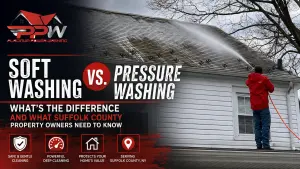


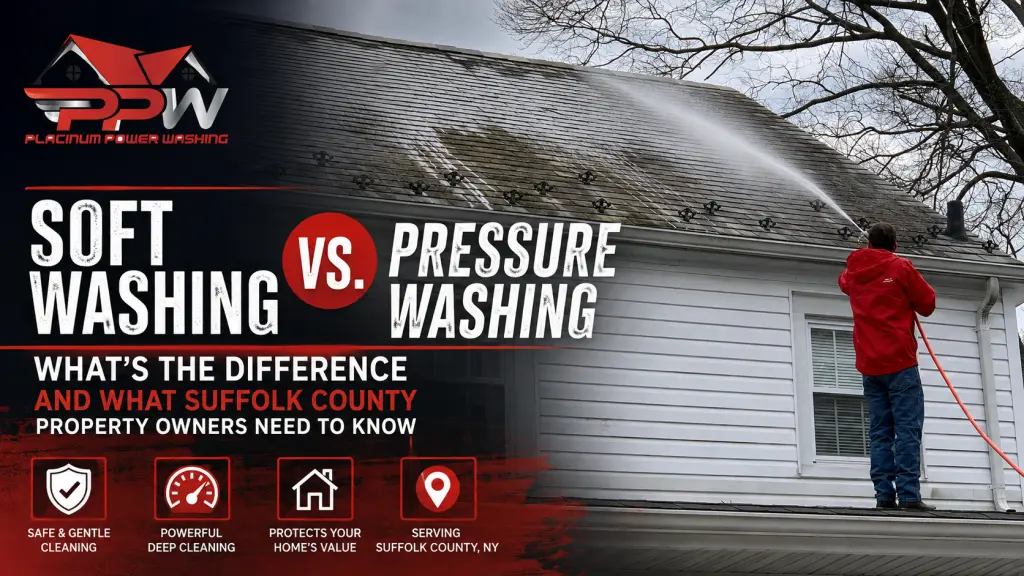
Soft washing uses low pressure (under 500 PSI) combined with cleaning solutions to kill algae, mold, and mildew at the root. Pressure washing uses high-pressure water (1,300 to 3,100+ PSI) to mechanically remove dirt and stains from hard surfaces. Most Suffolk County homes need both methods: soft washing for siding and roofs, pressure washing for driveways and concrete.
You’ve probably noticed them. Black streaks creeping down your roof. A green film building on the north side of your siding. A driveway that used to look a lot lighter than it does right now. If you live in Suffolk County, these problems aren’t unusual. They’re practically guaranteed.
Suffolk County averages about 42 inches of rain per year, and summer humidity regularly pushes past 70%. Add in salt air from the Atlantic, and you’ve got ideal conditions for algae, mold, and mildew to take hold on every exterior surface of your home. The question isn’t whether your property needs cleaning. It’s which cleaning method is safe for each surface.
We’ve been cleaning homes across Suffolk County since 2017 using truck-mounted commercial-grade equipment. This guide covers exactly which method goes where on your property, what the process looks like, and what to look for before you hire anyone.
What Is Soft Washing?
How the Chemistry Works
The cleaning power in a soft wash comes from the solution, not the water pressure. We apply sodium hypochlorite (a professional-grade form of bleach) mixed with a surfactant that helps it cling to the surface and soak into pores. The pressure stays under 500 PSI, just enough to deliver and rinse the solution.
The solution kills biological growth (algae, mold, mildew, moss, lichen) at the cellular level. Because the organism is eliminated rather than displaced, results last significantly longer: often two to five years on roofs and one to three years on siding. Pressure washing a moldy surface is like mowing weeds. They look gone, but the roots are still there. Soft washing pulls them out entirely.
How We Protect Your Property
We adjust our chemical concentration based on the surface material. Vinyl siding needs a lighter mix. Brick, wood, and cedar require a stronger solution.
Before we apply anything, we pre-wet all plants, shrubs, and landscaping around the house. We continue wetting during the application, rinse everything afterward, and apply a neutralizer to stop any residual chemical from affecting your landscaping. If you have expensive or sensitive plants close to the foundation, we cover them.
Windows and shutters get pre-wetted too. Shutters in particular can fade if chemical solution sits on them in direct sunlight, so we soak them first to create a water barrier.
What Is Pressure Washing?
When High Pressure Is the Right Call
Pressure washing uses high-pressure water, typically between 1,300 and 3,100+ PSI, to mechanically blast dirt, stains, and buildup off hard surfaces. It’s fast, it’s visible, and on the right surfaces, it’s extremely effective.
The key phrase there is “on the right surfaces.” Concrete driveways, brick walls, stone patios, and pavers can handle the force. Vinyl siding, roof shingles, painted wood, and stucco cannot. A professional crew should be switching between methods throughout a single visit, based on what each surface requires.
Our Pressure Washing Process
We start with a pre-treatment: a surfactant and sodium hypochlorite solution applied to the surface before we touch it with pressure. This loosens embedded grime and kills biological growth so the pressure washer can focus on removing what’s left.
We use a commercial surface cleaner, a rotating disk that distributes pressure evenly instead of concentrating it in one narrow line. After the surface is clean, we edge details with a power washing wand and finish with a post-treatment solution to kill any remaining moss or mold spores. This post-treatment step is what separates a cleaning that lasts from one that looks good for a few weeks.
Soft Washing vs. Pressure Washing: The Complete Comparison
This table covers every factor that matters when deciding which method to use. We’ve included Suffolk County-specific pricing based on the jobs we see most often.
| Feature | Soft Washing | Pressure Washing |
| Pressure (PSI) | Under 500 PSI | 1,300 to 3,100+ PSI |
| Cleaning method | Chemical treatment (SH + surfactant) | Mechanical force (water pressure) |
| How it cleans | Kills biological growth at the root | Blasts contaminants off the surface |
| Best surfaces | Vinyl siding, roof shingles, painted wood, stucco, cedar, composite decking | Concrete driveways, brick, stone patios, pavers |
| Surfaces to avoid | None when done professionally | Roof shingles, vinyl siding, painted surfaces, soft wood |
| How long results last | 2–5 years (roofs), 1–3 years (siding) | Months. Growth returns faster because it’s not killed at the source |
| Risk of damage | Very low with a trained crew | High if used on the wrong surface or at the wrong PSI |
| Cost range | $0.15–$0.30 per sq ft | $0.10–$0.25 per sq ft |
| Typical Suffolk County house wash | $299–$699 | N/A. Houses should be soft washed, not pressure washed |
| Typical Suffolk County driveway | N/A for most driveways | $250–$500 |
Soft washing costs more per square foot because of the cleaning solutions, but the cost per year of cleanliness is lower because you’re cleaning every few years instead of every few months.
Which Method for Which Surface? Your Suffolk County Home Guide
Every surface on your property has a correct cleaning method. Using the wrong one can cause expensive damage. Here’s a surface-by-surface breakdown based on what we see across Suffolk County homes every week.
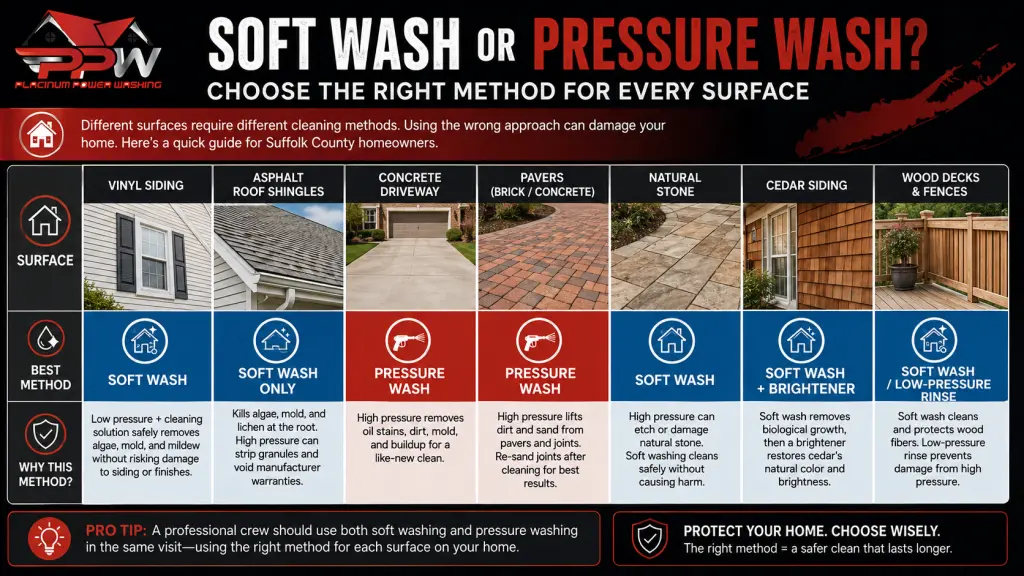
Vinyl Siding: Soft Wash Only
Vinyl is the most common siding type we clean across Suffolk County. High pressure can crack panels, force water behind the siding into the wall cavity, and create hidden moisture problems that lead to mold inside the wall.
We apply a diluted SH and surfactant solution, allow it to dwell, and rinse at low pressure. The strength of the mix and the dwell time are what produce the results, so there’s no need for force that could damage the surface.
Roof Shingles: Soft Wash Only, No Exceptions
This is the one that matters most, and it’s where the wrong choice costs the most money.
What ARMA Recommends
The Asphalt Roofing Manufacturers Association (ARMA) specifically recommends low-pressure, bleach-and-detergent-assisted washing as the preferred method for cleaning asphalt shingle roofs. Pressure washing above 1,500 PSI causes measurable granule loss on standard shingles. Those granules are the protective layer that shields your roof from UV damage and weather. Strip them, and you’ve shortened your roof’s life and potentially voided the shingle manufacturer’s warranty.
What’s Actually Growing on Your Roof
The black streaks you see on roofs all over Suffolk County are caused by Gloeocapsa magma, a type of cyanobacterium (often called blue-green algae). It feeds on the limestone filler in asphalt shingles and creates a dark pigmented coating to protect itself from sunlight. That’s why the streaks look like they’re painted on. They’re alive. Manufacturer studies have shown that algae-colonized shingles deteriorate significantly faster than clean shingles, which is why treating those streaks early is one of the most cost-effective maintenance steps a homeowner can take.
How We Clean a Roof
Our roof soft washing process starts by blowing debris off the roof with a blower. We run a two-person crew: one applying the solution from the ladder or gutter line, one on the ground managing overspray and wetting plants.
If your downspouts connect to drainage systems near landscaping, we bag them off to prevent chemical-laden water from reaching plants through the drainage path. On asphalt shingle roofs, we apply the solution and let it work. We don’t rinse it off with pressure. The rain takes care of that over the following weeks, and heavy growth may take one to three months to fully clear. If moss or algae persists after the initial treatment, we come back for a second application at no extra charge.
We also inspect every roof for damage while we’re up there. If we spot cracked shingles, flashing issues, or anything concerning, we’ll take pictures and walk you through what we found.
Concrete Driveways and Sidewalks: Pressure Wash
Concrete is hard, dense, and built to take a beating. This is where pressure washing excels. Our surface cleaner distributes even pressure across the concrete, and we pre-treat and post-treat with solution to make the results last longer.
One exception: if your concrete is less than a year old, we soft wash it instead. New concrete hasn’t fully cured and can be damaged or etched by high pressure.
Many Suffolk County homes have aging concrete driveways that collect moss, algae, and tire marks year after year. An annual or biannual pressure wash keeps them looking right and prevents slip hazards from biological growth in shaded areas.
Pavers and Stone Patios: Pressure Wash, With Important Exceptions
Paver patios and pool decks are everywhere in Suffolk County, and they need a different approach depending on the material.
Standard pavers (brick, concrete pavers) get pressure washed with a surface cleaner. We clean the growth out of the joints and off the surface. If you’re planning to have them re-sanded and sealed afterward, we do a more thorough cleaning to prep the joints properly for new polymeric sand.
Natural stone is different. We soft wash natural stone instead of running a surface cleaner over it, because the high-pressure disk can chip or etch the surface.
Pool decks, whether standard pavers or natural stone, come with an extra consideration: homeowners want to know if cleaning will push debris into their pool. We direct our spray outward and use a second crew member to redirect water away from the pool, but we always set realistic expectations that some splash can occur. Most homeowners schedule the cleaning right before their annual pool opening so their pool service handles any residual debris.
Cedar Siding: Soft Wash with a Brightener Step
Cedar is a specialty surface that not every company handles correctly. The process is different from a standard vinyl house wash in several ways.
We soft wash cedar with a stronger chemical concentration than we’d use on vinyl. We rinse the windows before, during, and after the wash because the extra solution volume means more potential for contact. After the wash, we apply a wood brightener to the cedar. This enriches the color and puts oils back into the wood so it doesn’t dry out from the cleaning.
It won’t look like the day it was installed. Every side of a cedar home ages differently because of sun exposure and weather patterns. The north-facing wall that stays shaded will look different from the south-facing wall that bakes all day. But the brightener brings the color back substantially, and the cleaning kills the growth that was breaking down the wood fibers.
Cedar house washes cost more than vinyl, typically between $750 and $2,500 depending on the home’s size and condition. The extra time, the stronger solution, and the brightener application all add up.
Wood Decks and Fences: Soft Wash with Low-Pressure Rinse
We pre-treat wood with a cleaning solution, allow dwell time, and rinse at reduced pressure. Composite decking gets an even lighter chemical mix. The goal is to clean the surface and kill the growth without forcing water into the wood grain or stripping the finish.
If the wood is rotted beyond cleaning, we’ll tell you. We’d rather be upfront about a deck that needs board replacement than take your money for a cleaning that won’t hold up.
Our deck and patio cleaning process follows the same plant protection and pre-wetting steps as every other service.
Why Suffolk County Homes Need Cleaning More Often Than You’d Expect
The Climate Working Against Your Home
Suffolk County’s climate works against your home’s exterior surfaces year-round. Summer humidity averages closer to 75% in August, salt air pushes inland from the Atlantic and Long Island Sound, and heavy tree canopy in neighborhoods from Huntington to Patchogue traps moisture on roofs and siding. North-facing walls and roof sections get the worst of it because they dry out the slowest.
Suffolk County sits in what roofing manufacturers call the eastern seaboard “algae danger zone,” where warm, humid conditions are exactly what biological growth needs to establish colonies.
The Financial Case for Regular Cleaning
The typical Suffolk County home is worth over $600,000 according to current market data, and homes in the county are selling at or above list price. A dirty, streaked exterior reduces curb appeal and can pull down appraisal values in a market where every dollar of property value counts. A professional soft wash costs a few hundred dollars. A roof replacement costs $15,000 to $30,000 or more. Regular cleaning protects both your home’s appearance and its most expensive structural component.
How Often to Clean and When to Schedule
We recommend soft washing your siding every two to three years and your roof every three to five years, depending on tree coverage and sun exposure. Driveways and concrete benefit from annual or biannual pressure washing. Homes under heavy tree canopy or on north-facing lots may need more frequent attention.
Late spring, typically May or June, is the best time to schedule exterior cleaning. Getting ahead of peak humidity prevents biological growth from accelerating through summer. A fall cleaning is also valuable for removing everything that built up during the warm months before winter locks it in place.
What to Look for When Hiring (and Red Flags to Avoid)
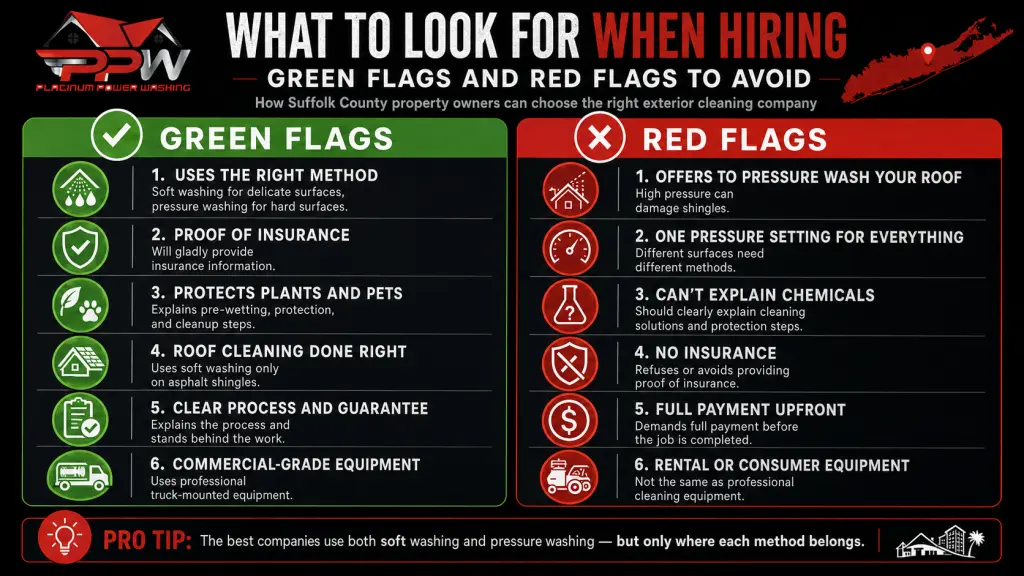
Not every exterior cleaning company understands the difference between soft washing and pressure washing, and the wrong approach can damage your property.
Signs of a Professional Company
Look for a company that uses both soft washing and pressure washing, choosing the right method for each surface. Other indicators of a professional operation:
- Free in-person estimates where someone actually walks your property and evaluates surfaces
- Proof of insurance
- A clear explanation of their plant and pet protection process before any work begins
- Manufacturer-compliant roof cleaning methods (soft wash only on shingles)
- A satisfaction guarantee
- Commercial-grade, truck-mounted equipment that delivers consistent results
Red Flags
Any company that offers to pressure wash your roof is an immediate disqualifier. It strips protective granules, shortens roof life, and can void your manufacturer’s warranty. Other warning signs:
- One pressure setting for every surface on the property
- An inability to explain what chemicals they use or how they protect your landscaping
- No insurance or a refusal to provide proof
- Requiring full payment upfront
- Consumer-grade equipment, the kind you’d rent from a hardware store, being used on a professional job
Schedule Your Free Estimate
If you’re not sure which method your home needs, that’s exactly what our free estimate is for. We’ll walk your property, look at every surface, and explain exactly what we’d do and why before you spend a dollar. You don’t need to be home for the cleaning itself. We communicate throughout the process via phone, text, and our scheduling system so you know when we arrive, when we’re working, and when we’re finished.
We’ve been cleaning homes across Suffolk County since 2017. We’re fully insured, we don’t collect payment until you’re satisfied, and we offer 10% off when you book two or more services.
Call us at (631) 603-2160 or email PPWLongIsland@gmail.com for a free, no-obligation quote.